
Best picks · three tiers
Best resin sheds
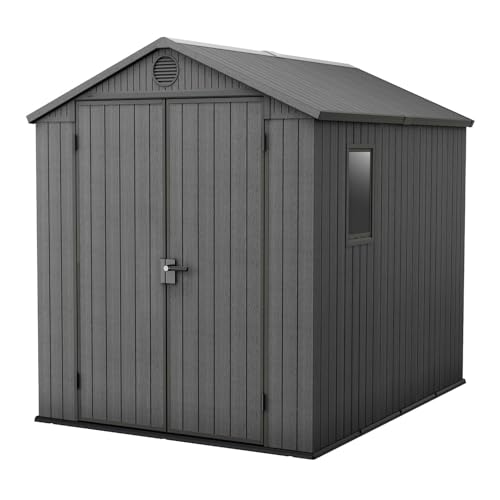
The Keter Factor 6x8 Resin Shed at $975.79 is the best resin shed for most yards: enough floor space for a mower and full shelving, a skylight and built-in vents, and zero paint or rust maintenance over its life.
Picks by budget: beginner, intermediate and expert
Aoxun Resin Outdoor Storage Shed

$499.99 · 6 x 8 ft
Who it is for: First-time shed buyers who want full-size resin storage without paying for a premium name.
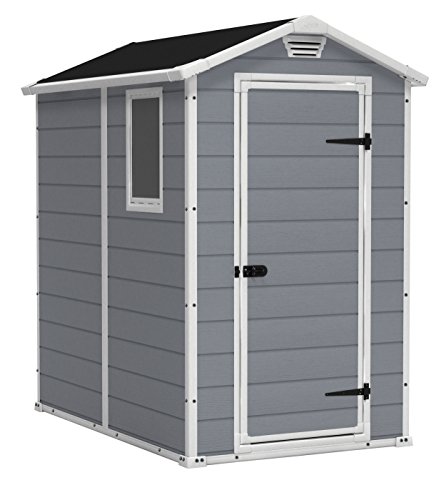
The Aoxun 6x8 resin shed runs $499.99, one of the lowest prices for a 6x8 resin kit whose listing states a floor is included, and it has a floor and lockable doors.
Skip it if: Anyone expecting a steel-reinforced frame or planning to store a riding mower.
Check price on AmazonLifetime Outdoor Storage Shed

$1,478.85 · 8 x 10 ft
Who it is for: Homeowners who want a large resin shed they will not outgrow or replace.
The Lifetime 8x10 at $1,478.85 uses dual-wall HDPE panels with a steel-reinforced frame, a skylight and a window, giving it more rigidity under wind and snow load than a single-wall resin panel.
Skip it if: Small yards where an 8x10 footprint will not fit or is overkill.
Check price on AmazonKeter Signature Collection 9x7 Ft All-Weather Storage Shed

$1,580 · 7 x 9 ft
Who it is for: Buyers who want the largest, most feature-rich resin shed on the market and are not shopping on price.
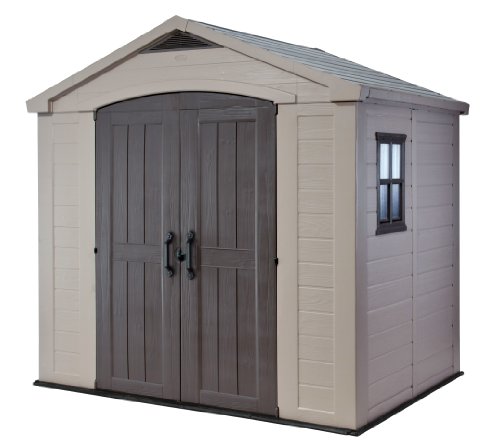
The Keter Signature Collection 9x7 at $1,580 adds a skylight, a window and built-in ventilation across a footprint large enough for a full workshop corner plus a mower, and Keter's Signature line uses a thicker panel wall than its entry Factor and Manor lines. Customizable interior wall panels, a feature Keter reserves for this collection, let you add shelving or hooks without drilling into the resin itself.
Skip it if: Anyone who only needs to store bikes, trash cans or hand tools; this is more shed than that job needs.
Check price on AmazonAlso worth a look

Prices change often; the button shows today's price on Amazon.
What makes resin the right material for your yard?
Resin (usually high-density polyethylene, HDPE) never rusts, never rots and never needs a coat of paint, which is why it dominates the mid-price shed market. The tradeoff is that resin panels flex more than steel under a ladder leaned against the wall or a heavy branch strike, and cheaper single-wall panels can fade or chalk in strong sun over several years.
Within resin itself there is a real construction gap worth knowing before you shop by price alone. Entry-level resin sheds use a single-wall panel that is lighter and cheaper but flexes noticeably in wind and can dent under impact. Dual-wall, steel-reinforced designs, like Lifetime's HDPE construction, sandwich a rigid core between two resin layers, closing much of that gap with steel without adding steel's rust risk. Keter's Signature line takes a third approach, thickening the resin wall itself rather than adding an internal steel skeleton.
Compare it directly against the alternatives in resin vs metal shed and vinyl vs resin shed.
How much resin shed do you actually need?
Resin sheds are sold by footprint, not usable capacity, and many small resin cabinets are marketed by cubic feet instead of floor dimensions. Measure what you are storing (mower, snow blower, bikes, bins), add 50 percent for aisle space, and round to the next standard size using the shed size calculator. Across our catalog, resin kits price out around $18 per square foot at the median, though small cabinets and premium Signature-line sheds sit well outside that average in either direction.
Door width deserves its own check, separate from floor area. A resin shed with a generous footprint can still have a narrow single door, which matters if a mower or snow blower is part of your storage list. The general rule on this site is at least 5 feet of clear door width for a 42 inch riding tractor deck; smaller equipment like a push mower or wheelbarrow needs less, but always confirm the specific spec rather than assuming from the overall size.
How do the picks stack up?
| Aoxun 6x8 | Lifetime 8x10 | Keter Signature 9x7 | |
|---|---|---|---|
| Price | $499.99 | $1,478.85 | $1,580 |
| Panel type | Single-wall resin | Dual-wall steel-reinforced HDPE | Thick-wall resin, Signature line |
| Skylight/window | No | Yes | Yes |
| Floor included | Yes | Yes | Check spec page |
What does assembly and the foundation actually involve?
Resin sheds bolt together from molded panels and generally go up faster than a wood kit, but every panel still needs to sit on a level, well-drained base or the doors will bind within a season. A gravel pad one foot larger than the shed footprint on every side, four inches deep, is the standard approach; see the full walk-through in how to assemble a resin shed. A 10x12 pad, sized for a 10x12 shed's slightly larger footprint, runs closer to 3.2 tons of crushed stone once the compaction margin is added, so scale your material order to the actual shed rather than reusing a smaller shed's numbers.
- Anchor every corner at minimum, plus one point every 6 to 8 feet on long walls
- Leave the skylight or vent panels unblocked; sealed resin boxes trap humidity around stored tools
- Check your local code before you build; permit thresholds vary by town
How we chose these picks
Nothing here was assembled or tested in person. We compared manufacturer specifications for panel construction, footprint, included floor and included windows or skylights, cross-checked price against the per-square-foot median for resin sheds in our catalog, and weighted recurring themes in verified owner reviews, especially door width, floor inclusion and reports of panel warping in direct sun. We also cross-checked each product's listed title against its footprint and material columns to avoid recommending a shed whose photos or name overstate its actual size or construction, a mismatch that shows up more often than buyers expect in this category.
Buying tips before you order
Read the listing carefully for whether the floor is included; this is the single most common surprise with resin sheds, since some models sell it as an add-on kit. Confirm the door swing clearance against your fence line or gate before delivery, since flat-packed panels for even a modest shed can be wide, and lift heavy panels with two people. Keep the packaging and hardware bags sorted by panel until assembly is finished, since resin kits often use similar-looking bolts across different panel sizes.
How do resin sheds hold up in wind and storms?
A well-anchored resin shed handles ordinary wind loads fine, but the panel itself is lighter than steel or wood, which makes anchoring the part you cannot skip. Corner anchors at minimum, with an additional anchor every 6 to 8 feet along the long walls, are what keep a resin box from shifting or lifting rather than the panel material itself. Dual-wall, steel-reinforced designs like the Lifetime line in this roundup add rigidity under a direct gust, but no resin panel replaces solid anchoring into a level pad.
If your yard is in a high-wind or coastal zone, favor a model with a steel-reinforced frame over a single-wall economy panel, and double-check the anchor kit included in the box; some budget resin sheds ship with only enough hardware for a mild climate and expect the buyer to add more.
The picks, side by side
Prices change often; the button shows today's price on Amazon.
More roundups
- Best shed anchor kits
- Best shed floor kits
- Best shed foundation kits
- Best shed ramps
- Best sheds for riding mowers
- Best trash can storage sheds
Get these picks and prices by email
One page with every item, quantity and current price, so you can cost the whole project before you buy any of it.
Used only to send the list. You can also just read it on this page.Frequently asked questions
How long do resin sheds last?
Manufacturer warranties on mid-range and premium resin sheds typically run 10 to 15 years, and HDPE resin itself does not rust or rot, so the realistic lifespan with a solid foundation and proper anchoring is often 20 years or more. The panels can fade or chalk slightly in intense sun over that span, which is cosmetic rather than structural.
Do resin sheds come with a floor?
Many do, but not all. Check the specific listing: some models advertise a molded floor built into the base panel, while others sell the floor as a separate kit or assume you will build directly on a concrete or gravel pad. This is the most common point of confusion in shed reviews, so read the spec page before ordering.
Can a resin shed handle snow load?
Most resin sheds are rated for moderate snow loads, but this varies significantly by model and panel thickness, with dual-wall, steel-reinforced designs handling more than single-wall economy panels. As a general guide, an unheated low-risk shed sees roughly 0.67 times the ground snow load before slope reduction; check the manufacturer spec for your specific climate.
Is a resin shed better than metal for a humid climate?
Yes, generally. Resin never rusts, which matters most in coastal or high-humidity regions where steel seams and screws need regular inspection and touch-up. Metal sheds remain a strong value elsewhere, but if corrosion is your top concern, resin removes that failure mode entirely.
What size resin shed fits a riding mower?
Most riding mowers need roughly 8 feet of width or depth to park with clearance to walk around, plus a door at least 5 feet clear for the equipment itself. An 8x10 or larger resin shed with double doors is the realistic minimum; always check the specific door width spec before buying rather than assuming from the floor dimensions.
This page is researched guidance, not professional engineering, legal or building-code advice. Sizes, loads and permit rules vary by product and by town: check your local code and the kit manufacturer's instructions before you build.